Resources · Free download

EU AI Act compliance handbook

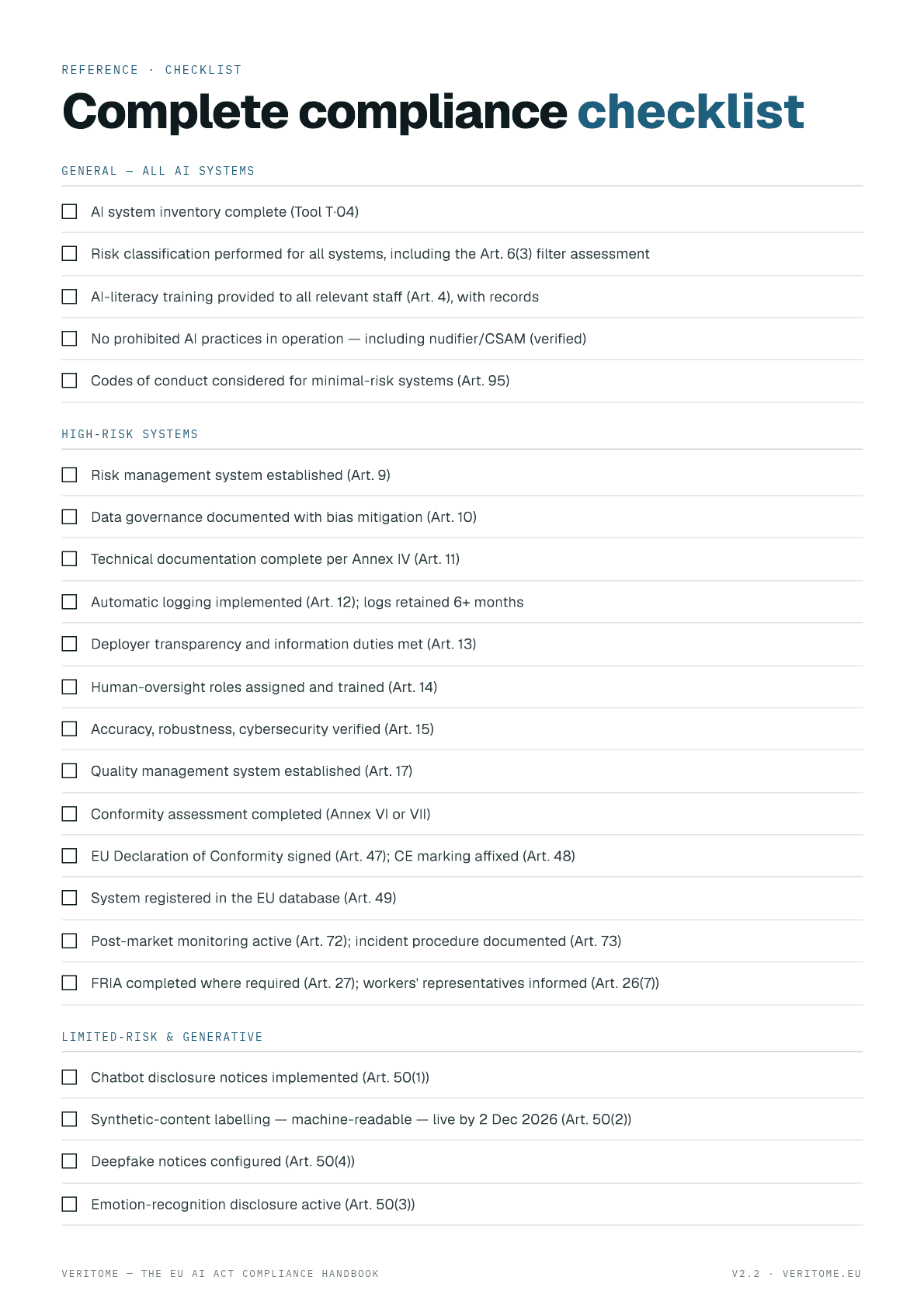
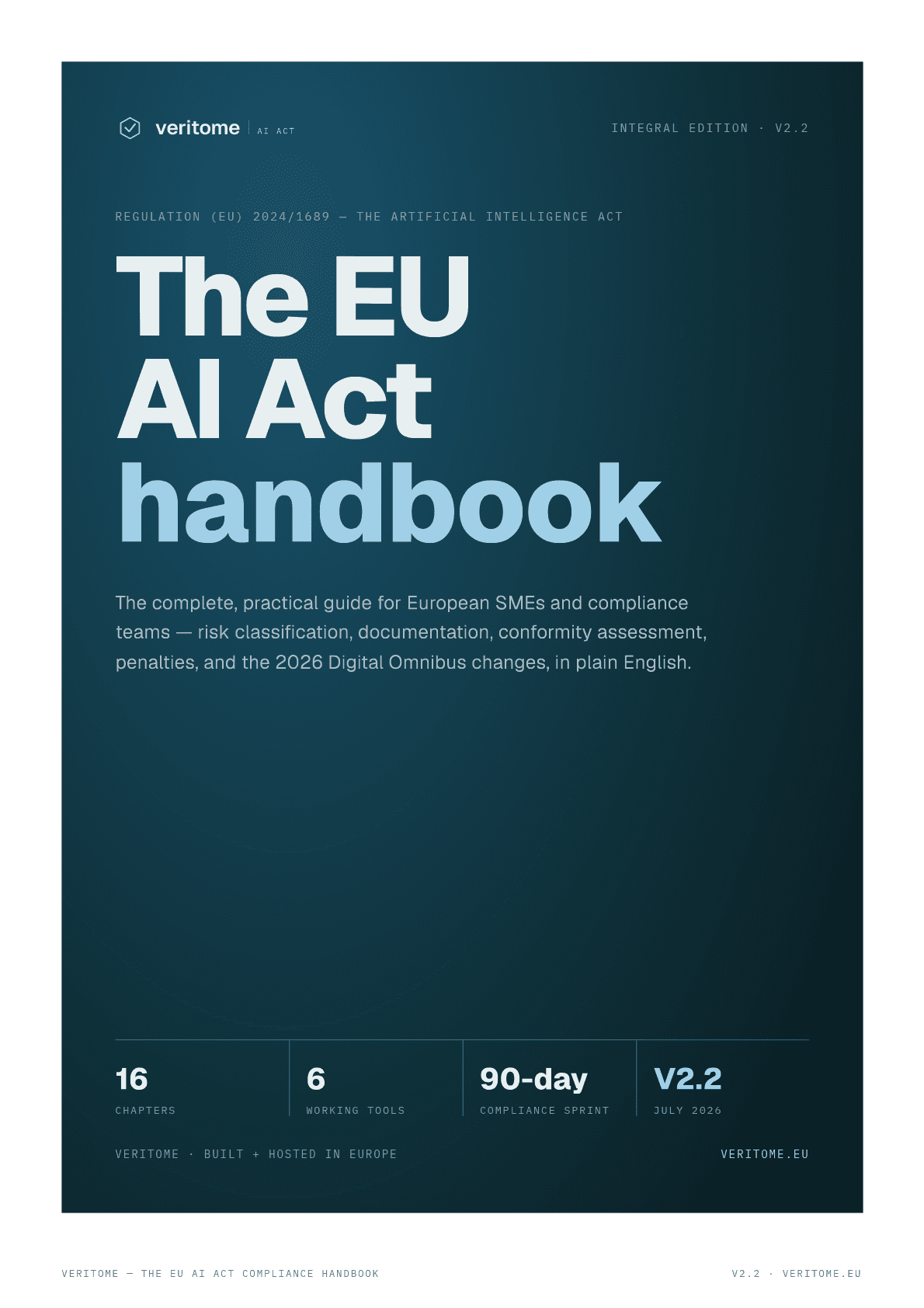
39 pages. 16 chapters. Every article of the EU AI Act explained in plain English with practical examples, checklists, and implementation guides.

No signup required. We'll send you compliance tips — unsubscribe anytime.

What's inside

16 chapters that take you from the framework to a documented evidence base

1

The risk-based framework

How the Act sorts every system into one of four tiers — and what each tier means for you. Decision trees walk you from a plain description to a defensible classification.

ProhibitedHigh riskLimited riskMinimal risk
2

The eight Annex III areas

All eight high-risk domains explained with real-world examples, so you can tell at a glance whether a system lands inside the high-risk perimeter.

BiometricsEmploymentEducationEssential servicesLaw enforcementJustice
3

Roles & obligations

Deployer, Provider, Importer and Distributor compared side by side — who owes what, and how obligations shift when you place a system under your own name.

Deployer (Art. 26)Provider (Art. 16)Importer (Art. 23)Distributor (Art. 24)
4

Documentation & evidence

What a complete file looks like: Annex IV technical documentation, the Fundamental Rights Impact Assessment, the EU Declaration of Conformity, and the records that back them.

Annex IV docsFRIA (Art. 27)DoCLogs (Art. 26(6))
5

Article 6(3) exceptions

When a listed system is not high-risk after all — the four exception conditions, the self-assessment record you must keep, and the Article 6(4) authority notification.

Narrow procedural taskNo profilingSelf-assessment recordAuthority notification
6

Timeline & enforcement

What applies when, from entry into force through full enforcement, plus the penalty bands — so you can sequence the work against real regulatory dates.

Aug 2024 in forceFeb 2025 prohibitionsDec 2027 high-riskFines to 7%

Why start with the handbook

Plain English, not legalese

Every article is translated into language a busy team can act on — with practical examples rather than recitals.

Built around the December 2027 deadline

High-risk obligations apply from December 2027 (moved from August 2026 by the 2026 Digital Omnibus). The handbook helps you sequence the work now.

Checklists you can use today

Each chapter ends with a short checklist so you can turn reading into a documented next step.

Deployer-first

Most EU organisations are Deployers, not Providers. The handbook prioritises Deployer obligations under Article 26.

Mapped to the regulation

Every claim is anchored to a specific article, recital or Annex — so your file points back to the source.

A path to automation

When you're ready to stop tracking by hand, the Veritome platform picks up exactly where the handbook leaves off.

Frequently asked questions

Who is this handbook for?

Anyone responsible for AI compliance in an EU organisation — compliance, legal, risk, and product leads — whether you deploy third-party AI tools or build your own systems.

Is it really free?

Yes, completely free. We ask for your email so we can send occasional compliance updates and tips — you can unsubscribe at any time.

How long is it?

39 pages across 16 chapters, covering classification, obligations, documentation, exceptions, and the enforcement timeline in plain English.

How is this different from the Veritome platform?

The handbook is the reading. The Veritome platform is the doing: it automates classification, generates the exact obligations that apply, and assembles verifiable documentation from your live data.

When does the EU AI Act apply?

Prohibited practices have been banned since February 2025; high-risk obligations apply from 2 December 2027 (postponed from August 2026 by the 2026 Digital Omnibus).

Get your free compliance handbook

Join thousands of compliance professionals preparing for the EU AI Act deadline.

No signup required. We'll send you compliance tips — unsubscribe anytime.