What's inside
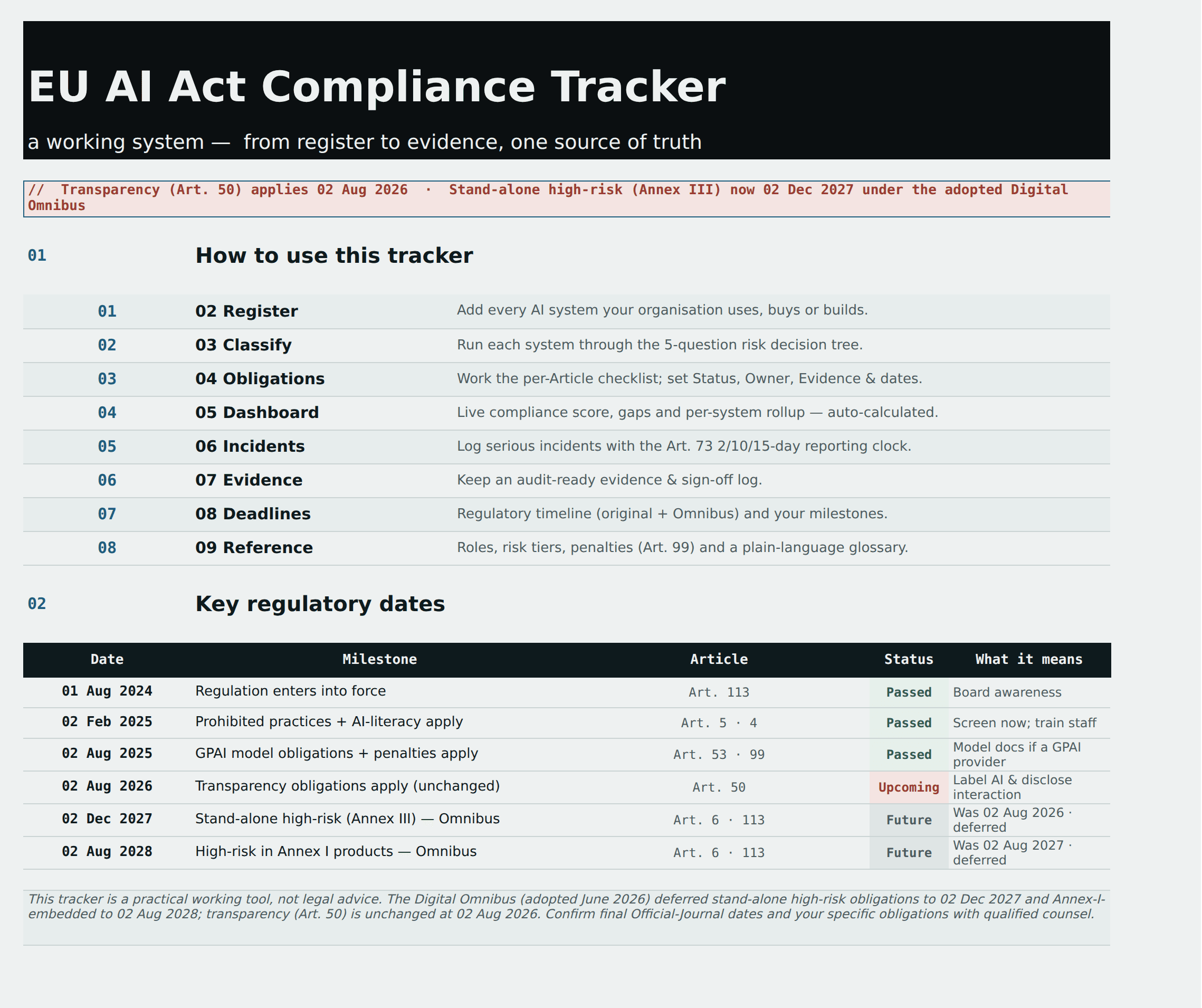
Nine worksheets designed to take you from a blank page to a documented evidence base
01 Start
How the workbook fits together, and the key regulatory dates with their status — what has passed, what is upcoming, and what the Digital Omnibus moved.
02 Register
Every AI system your organisation uses, buys or builds. Vendor, department, role, deployment status and owner — the register everything else keys off.
03 Classify
The 5-question decision tree — stop at the first yes. Backed by the eight Annex III domains with typical examples, so a borderline system lands somewhere defensible.
04 Obligations
The per-article checklist. Set status, owner, evidence and dates against each duty; the dashboard reads straight off this sheet.
05 Dashboard
Obligation completion, open gaps and a per-system rollup — all formula-driven, so it moves as you work rather than needing to be maintained.
06 Incidents
Serious-incident log running the Article 73 reporting clock — 15 days as standard, 10 where a death may be involved, 2 for widespread infringement or critical-infrastructure disruption.
07 Evidence
An evidence and sign-off log for audit preparation: what proves each obligation, who signed it off, and when it needs looking at again.
08 Deadlines
The regulatory timeline with the original and Omnibus dates side by side, plus space for your own internal milestones.
09 Reference
Roles, risk tiers, the Article 99 penalty bands and a plain-language glossary — so nobody has to leave the file to check a term.
Why start with this tracker
December 2027 deadline
Standalone high-risk AI obligations take effect, deferred from August 2026 by Regulation (EU) 2026/1744. Start documenting now to avoid fines up to 3% of global turnover.
Pre-built templates
No blank spreadsheets. Every tab comes pre-populated with sample data, drop-downs, and status tracking.
Based on the regulation
Obligations mapped directly to Articles 5, 6, 26, 27, and Annexes I-III. Plain language explanations included.
Works for any org size
Whether you have 1 AI system or 50, the tracker scales. Add rows as you discover and register more systems.
Deployer-first approach
Most EU organisations are Deployers, not Providers. This tracker prioritises Deployer obligations under Art. 26.
Upgrade path
When you're ready for automation, the Veritome platform picks up where this tracker leaves off.
Frequently asked questions
Who is this tracker for?
Any organisation that uses or develops AI systems in the European Union. Whether you're a Deployer using third-party AI tools or a Provider building AI models, this tracker helps you get organised before the high-risk deadline of 2 December 2027, deferred from 2 August 2026 by Regulation (EU) 2026/1744.
Is this really free?
Yes, completely free with no strings attached. We ask for your email so we can send you useful compliance updates and tips — you can unsubscribe at any time.
What's the difference between this tracker and the Veritome platform?
This Excel tracker is a manual starting point. The Veritome platform (launching soon) automates everything: AI-powered risk classification, obligation generation, team workflows, evidence management, audit documentation, and ongoing monitoring.
Can I share this with my team?
Absolutely. Share it across your organisation. For team collaboration with version control, approval workflows, and audit trails, the Veritome platform will be the right solution.
When is the EU AI Act enforcement deadline?
The main deadline is 2 December 2027, when standalone Annex III high-risk obligations take effect. It was deferred from 2 August 2026 by Regulation (EU) 2026/1744, in force since 27 July 2026. Earlier duties already bite: prohibited practices since February 2025, GPAI obligations since August 2025, and Article 50 transparency since 2 August 2026.
Get your free compliance tracker
Join thousands of compliance professionals preparing for the EU AI Act deadline.